
We’re kicking off a new endeavor to provide programming and pertinent information to people interested in Canadian culture and heritage.
5/21/26 The Elusive Tourtiéres- Traditional Canadian Pork Pie
In the early period of Canadian history, Samuel de Champlain founded Port Royal –the first permanent settlement in New France– in Nova Scotia (Acadia) in 1605. In 1606, Champlain founded a “gourmet club” called The Order of Good Cheer. It was probably the first organization of its kind, intended to raise the spirits of the group. In this group, each person was responsible for creating dinners for the other members and they tried hard to outdo one another. Unfortunately for us, they did not write down their recipes. Some time ago CBC Radio attempted to recreate dishes that potentially could have been served at these dinners. Not apparent in these recipes were the simple dishes that I associate with regional Canadian cuisine. It is my endeavor to verify the origins of the famous tourtiéres in New France, a ubiquitous dish analogous with regional Canadian cuisine.
It was shortly after Champlain’s time, that my matrilineal family came from La Rochelle, France to New Foundland. My grandfather Joseph Arsenault (Arcenaux, Arceneault) (a ship’s captain) and his brother Pierre came to Acadia in the mid 1700’s. My uncle went on to the Parish of Louisiana and my grandfather’s descendants then traveled through the east coast, into Michigan and back into Canada in the early 19th C. My roots as a French-Canadian reach back as well, to include my family who are Metis-Indian from Walpole Island and Pointe-Aux-Roches Ontario Canada, a Francophone community up until the first half of the 1900’s. My grandmothers’ cooking was famous, and I studied at her knee for a large part of my childhood. Tourtiére was a dish commonly served in our home, sometimes being comprised of pork, beef (or a combination thereof) bacon or –when available– venison. Regional Canadian cooking was not something I was aware of, only that I cooked how I was taught. These recipes were handed down generation to generation. My pie dough recipe for example, is at least 150 years old, having been given to me in 2001 by a pie maker who at the time was at the age of 82. In turn, the recipe was handed down to her while she was in her early 20’s by her 90-year-old great aunt, who received it from her own grandmother. This recipe is included below
The food served at Port Royal in the early 1600’s is not going to be rendered exactly in the recipes I was handed down. They are based on recipes and cooking techniques that would have been brought with the explorer, rooted in the cuisines of medieval France. The ingredients and the execution of those recipes however, were most likely not completely familiar to the medieval cook. Having to rely on whatever was available in New France in the dead of winter, there would have been little option but to create recipes that used substitutions.
Over centuries, the recipe for the classic traditional pork pie, tourtiéres , evolved. Its roots can be found in the recipes of Taillevant (1300’s-1400’s), Master Chiquart (mid 1500’s) and later Francois Pierre La Varenne (mid 1600’s) and I’ll share those in the follow paragraphs. As with all recorded haute cuisine the first recipes are food created for nobles and the gentry who accompanied them in dining. These recipes generally reflected expensive ingredients, often ostentatious in their use in order to exemplify the grandeur of the table guests. Unlike the regional cuisine of the commoners, these dishes were often made with labor intensive and complicated methods requiring the hands of skilled cooks and plenty of unskilled kitchen workers. And unlike the cuisine of the nobles, these common recipes were rarely written down for posterity’s sake leading us to the application of cultural anthropology to get a better look at these undocumented recipes.
The first known Canadian cookbook was “La cuisinière Canadienne, contenant tout ce qu’il est nécessaire de savoir dans un ménage, pour préparer les diverses…. Montréal: L. Perrault, 1840”
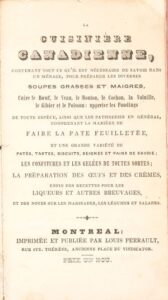
found here http://www.collectionscanada.gc.ca/cuisine/002001-100.01-e.php
Although much later than our period of Early New France, this cookbook is written in French recipes in an early style, unredacted (primarily with no quantities or extended and defined directions). This approach to recipes was not changed until the development in the late 1800’s by Fannie Merritt Farmer in “The Boston Cooking-School Cook Book” 1896.
From what I can deduce, this mid 19th C. Canadian cookbook is the first to describe a recipe for what we could now say is the traditional Canadian Tourtiéres , a ground pork meat pie, seasoned with spices and herbs, baked in a crust.
Before we accept this recipe as a tourtiéres, however, we should examine its earlier predecessors that show a development from medieval style recipes of complicated form and ingredients, through to a simplification and refinement in the revolutionary 18th C. whose recipes differ from the 19th C rendition.
The Medieval Influence
Following is a brief analysis of recipes from the most significant cookbooks printed before the period of Samuel de Champlain’s exploration of Canada as well as continually reprinted for centuries after their first publication;
Please note that any comments or explanations I add will be in parenthesis.
Medieval Recipes for Pork Pies;
The following two recipes are probably one and the same, one an earlier version of the other. Note the basic and main ingredients ground mutton, veal or pork, bacon (plus additional herbs, spices, fruit, nuts, poultry as is common in medieval cuisine) baked in a crust.
Original Recipe: French Master Chef to King Charles the V and VI, Taillevent (Guillaume Tirel) 14th Century France[i]
This recipe is very ostentatious with gold leaf and flags and crenellated pastry to look like castle walls. But the fundamental ingredients and style is very much in the spirt of our elusive pork pie. Minced meat, with seasonings, and in this case fruit and nuts.
197: Tourtes parmeriennes: Parmesan Pies. Take mutton, veal or pork and chop it up sufficiently small; then boil poultry and quarter it — and the other meat must be cooked before being chopped up: then get fine powder and sprinkle it on the meat very sensibly, and fry your meat in bacon grease. Then get large open pastry shells — which should have higher sides than usual and should be the size of small plates — and shape them with crenellations; they should be of a strong dough in order to hold the meat. If you wish, you can mix pine nut paste and currants among the meat, with granulated sugar on top; into each pastry put three or four chicken quarters in which to plant the banners of France and of the lords who will be present, and glaze them with moistened saffron to give them a better appearance. For anyone who does not want to go to such expense for poultry, all he has to do is make flat pieces of pork or of mutton, either roasted or boiled. When the pies are filled with their meat, the meat on top should be glazed with a little beaten egg, both yolks and whites, so that this meat will hold together solidly enough to set the banners in it. And you should have gold-leaf or tin-leaf to glaze the pies before setting the banners in them.
Here is another French pork pie, this time from the 15th Century. Much more detailed and complicated and layered with other game, poultry, fruit, nuts, herbs and spices this time with cheese added.
Parma Tarts- Master Chiquart- 15th C (1420’s) [ii]
This recipe although extremely long, is an interesting read. Prepared for a huge feast, the proportions are gargantuan but the technique intricate.
21: Again, parma tarts: for the said parma tarts which are ordered to be made, to give you understanding, take three or four large pigs and, if the feast should be larger than I think, let one take more, and from these pigs remove the heads and the hams, and put the fat apart to be melted; and take the said pigs and cut them into fair slices or pieces and wash them very well and put them to cook in fair and clean cauldrons, and put in salt in measure. And for the said parma tarts you will need three hundred pigeons, two hundred very young chickens — and if it happens that the feast is given at a time when there are no very young chickens, have one hundred young capons — six hundred small birds; and these pigeons, poultry, and small birds should be plucked and cleaned properly and cleanly; and take the pigeons and split them in half, and also split the poultry and cut it in quarters; and then take the pigeons, poultry, and small birds and put into fair small casks, wash properly and cleanly three or four times in fair and clean water, and then put them to boil in fair and clean cauldrons, and put in salt in measure; and check that it does not cook too much; and, being cooked subtly, draw out your meat into fair and clean cornues and put your small birds in one place and the other meat in another. And then take your pork fat and cut a great deal of it and put into fair and clean pans and melt well and, being well melted, strain it into other fair and clean pans; and then take your small birds and sauté them in your lard lightly and not too much, and also next the other meat. And of figs six pounds and six pounds of dates, of pine nuts six pounds, of prunes six pounds, of raisins eight pounds; and then take your figs, prunes, and dates and cut them fine — as small as the smallest raisins — and remove the stems from the raisins and clean them well. And then take your pine nuts and rub them very well, then winnow them on fair platters; then put them on a fair cloth and pick them over and clean them well and properly so that there remains nothing but the white nutmeat. And then put your figs, prunes, raisins, dates, and pine nuts into a fair, white and clean cornue, and let it be well covered with a fair, white and clean cloth so that nothing which is not clean falls therein. And then arrange that you have herbs, that is sage, parsley, hyssop and marjoram, of which have such a large amount of parsely that you have a great bowlfull drained and with the leaves stripped off the stems, and sage, hyssop, and marjoram added in measure; then put them in a fair and clean cornue, and wash them well and properly in three or four changes of fresh water, and then put them on fair and clean boards and chop them very small. And check to see if your pork is cooked and put it on fair tables, and you should have your fair, large and very flat boards; and you who are making this fair parma tart, together with the assistants which you have assigned to it, take care to remove the skin of the said pigs and let no bones remain, and chop your meat very small; and in chopping your said meat take herbs and put them in with your meat; and then have a large, fair, clean and clear basin [bacine] and put your said meat therein — and to give understanding of what the basin is, I mean that this should be a fair and large pan of those in which one cooks big and large fish. And then arrange that you have a quintal of best Crampone or Brie cheese or the best cheese which can be found, and then take the said cheese and pare and clean it well and properly, and cut it small, then bray it in a mortar very well and strongly; then take six hundred eggs and moisten your cheese therewith in braying, and continually sprinkle with the said eggs so that they are well bound and moistened and according to the quantity of the parma tarts which you are ordered to make. And take the pan which I described to you above, and put therein lard which is refined in which one has sautéed the meat, and put it in according to the quantity of the stuff which you have, and let it be put over a fair clear fire; and have two good strong assistants stirring the filling strongly and firmly with a great slotted spoon with two hands, and then let it down over a fair fire of clear coals; and let your figs, prunes, dates, raisins, pine nuts, cut as is said above, be washed two or three times in fair, clean and clear water and then afterward washed in good white wine and then put to drain and dry on fair and clean boards; and then, being drained, throw it into your filling, and let it be very well stirred in; and then take your cheese which has been brayed and moistened with egg as is said above — the quantity which you have made for the said filling — and put into your filling while braying well and strongly; and take the said pan off the fire. And take your spices, white ginger, fine powder, grains of paradise, saffron to give color, and put in cloves in measure, put them therein and stir continually; and have a great deal of sugar beaten into powder and throw in a great deal according to the quantity of the filling, and stir continually. And arrange that you have fair and clean pans, or if you find fair and clean ceramic dishes take as many as you need to make your parma tarts in such great quantity that you will have some left over; and then when you have your fair and clean pans or ceramic dishes arrange that you have two or three thousand sugared wafers, and then take your pans or your ceramic dishes and take some of the lard in which you fried your small birds and poultry and put into your pans or ceramic dishes and then take your wafers and put in each dish on the bottom and around it a layer of the said wafers so that there are four or five one on another; and on the said wafers take of the said filling and make a layer, and then on top of the filling put the small birds here and there and not together; and put between two small birds a quarter of a pigeon and elsewhere a quarter chicken between two small birds, and do this in such manner that of small birds, quarter pigeons and quarter chickens there is made well and adroitly a layer set on top of the layer of the filling; and on top of this layer made of small birds, quarter pigeons, and quarter chickens is made another layer of the said filling, and on top of this layer made of filling put wafers in the fashion and manner which is said above as they were put on the bottom of the said pan or ceramic dish; and, this being done, they should be covered well and properly with the said wafers. Then take cold lard and put on top, and then put your tarts in the oven which has been well heated; and you will be well advised when they cook to have leaves of spinach and white chard well cleaned and washed so that, if the said wafers burn at all, you can put them on top. And then draw out your parma tarts and scrape them well and properly so that there remains nothing burned, and then put them on fair serving dishes; and, with them on the serving dishes, take your gold leaf and put it on your parma tarts in the manner of a chessboard, and powdered sugar on top. And when one serves it, let on each tart be put a little banner with the arms of each lord who is served these parma tarts.
Le Cuisinier Francais, 1653 translation of 1651 edition, Pierre Francois La Varenne-Introduced by Philip and Mary Hyman[iii]
In this later corpus of recipes, we find that the pastry section does not mention pork but does mention veal, venison, lamb, mutton and most significantly boar and a gammon of bacon. Most fillings for pies are large joints of meat or birds, veal and assorted fruit or seafood fillings. Pasties or hand held meat pies were made only of ham, mutton, venison and wild boar. Pork in and of itself was used in recipes roasted, stuffed, with a sauce, boiled or salted. Tourtes appear to be a variety of minced meats, combined with other items such as sweetbreads, mushrooms, cardoons. Sometimes these tourtes were combined with spices, sugar and herbs.
The types of pastry were either a simple flour, hot water crust a short crust (with lard or butter) or a puff pastry (choux pastry). The hardiest of these being the hot water crust with butter.
The recipes from La Cuisinière Canadienne, 1840[iv]
Here we get to the meat of the matter. The recipes I was taught to make. These recipes were translated by me, forgive me for any errors.
Des Pâtés du Tourtiéres
Il n’ya a que ceux au porc frais, qui se cuisent avec de la pâte au fond du plat, dans tour les autres, on n’en met générlament qu’environ une bordure du quatre doigts, tout aurtour du plat; puis on y place la viande avec parti du jus, jusqu’á la bordure il faut employer un plat creux, et on suivra des reste le directions ci-dessous
Translation
It has only those with the fresh pig, which are cooked with paste at the bottom of the dish, in turn the others, one does not put of it generally (other types of meat?), that approximately the edge of the (pie dough is) four fingers, all around the dish(an overhang); then one places there the meat with part of the juice, until the edge, it is necessary to employ a hollow dish, and one will follow the rest of the directions below
Au Muton
Faites revenir vos morceaux de muton ton dan le poële avec saindoux, les ayant poudrés de farine, avec poire, sel et tête de clous*, quands ils seront rôtis, ajoutez parsil, thym, marjolaine, avec une dimiarre d’eau; si vous trouvez que c’est assaisonné, fait les tout bouillir un moment, et jettez le dans un plat creux garni de quatre doigts de pâte autour; courvrez de pâte, laissant une overture au milieu, pour on bouquet de pâte, que vous leverez avec soin, quand le pâte sera cuit pour jetter un peu de jus que vous arez conserve, ce qui empêchera votre pâté d’être sec.
In Mutton
Return your pieces of mutton to your stove with lard, having powdered them with flour, with pepper, salt and cloves, when they will be roasted, add parsley, thyme, marjoram, one starts with water; if you find that it is seasoned, makes the whole boil one moment, and put it in a hollow dish furnished with four fingers of paste around; will cover of paste, leaving a overture to the medium (an edge), for one bouquet of paste, which you will raise carefully, when the paste is cooked(indicating hot water pastry?) for put a little juice which you will preserve, which will prevent your pie from being dry
*Tête de clous- Old French clou de girofle, literally: nail of clove, …
The Elusive Tourtiéres- Traditional Canadian Pork Pie
January 2, 2024 · Channon Mondoux ·
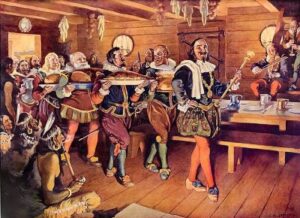
In the early period of Canadian history, Samuel de Champlain founded Port Royal –the first permanent settlement in New France– in Nova Scotia (Acadia) in 1605. In 1606, Champlain founded a “gourmet club” called The Order of Good Cheer. It was probably the first organization of its kind, intended to raise the spirits of the group. In this group, each person was responsible for creating dinners for the other members and they tried hard to outdo one another. Unfortunately for us, they did not write down their recipes. Some time ago CBC Radio attempted to recreate dishes that potentially could have been served at these dinners. Not apparent in these recipes were the simple dishes that I associate with regional Canadian cuisine. It is my endeavor to verify the origins of the famous tourtiéres in New France, a ubiquitous dish analogous with regional Canadian cuisine.
It was shortly after Champlain’s time, that my matrilineal family came from La Rochelle, France to New Foundland. My grandfather Joseph Arsenault (Arcenaux, Arceneault) (a ship’s captain) and his brother Pierre came to Acadia in the mid 1700’s. My uncle went on to the Parish of Louisiana and my grandfather’s descendants then traveled through the east coast, into Michigan and back into Canada in the early 19th C. My roots as a French-Canadian reach back as well, to include my family who are Metis-Indian from Walpole Island and Pointe-Aux-Roches Ontario Canada, a Francophone community up until the first half of the 1900’s. My grandmothers’ cooking was famous, and I studied at her knee for a large part of my childhood. Tourtiére was a dish commonly served in our home, sometimes being comprised of pork, beef (or a combination thereof) bacon or –when available– venison. Regional Canadian cooking was not something I was aware of, only that I cooked how I was taught. These recipes were handed down generation to generation. My pie dough recipe for example, is at least 150 years old, having been given to me in 2001 by a pie maker who at the time was at the age of 82. In turn, the recipe was handed down to her while she was in her early 20’s by her 90-year-old great aunt, who received it from her own grandmother. This recipe is included below.
The food served at Port Royal in the early 1600’s is not going to be rendered exactly in the recipes I was handed down. They are based on recipes and cooking techniques that would have been brought with the explorer, rooted in the cuisines of medieval France. The ingredients and the execution of those recipes however, were most likely not completely familiar to the medieval cook. Having to rely on whatever was available in New France in the dead of winter, there would have been little option but to create recipes that used substitutions.
Over centuries, the recipe for the classic traditional pork pie, tourtiéres , evolved. Its roots can be found in the recipes of Taillevant (1300’s-1400’s), Master Chiquart (mid 1500’s) and later Francois Pierre La Varenne (mid 1600’s) and I’ll share those in the follow paragraphs. As with all recorded haute cuisine the first recipes are food created for nobles and the gentry who accompanied them in dining. These recipes generally reflected expensive ingredients, often ostentatious in their use in order to exemplify the grandeur of the table guests. Unlike the regional cuisine of the commoners, these dishes were often made with labor intensive and complicated methods requiring the hands of skilled cooks and plenty of unskilled kitchen workers. And unlike the cuisine of the nobles, these common recipes were rarely written down for posterity’s sake leading us to the application of cultural anthropology to get a better look at these undocumented recipes.
The first known Canadian cookbook was “La cuisinière Canadienne, contenant tout ce qu’il est nécessaire de savoir dans un ménage, pour préparer les diverses…. Montréal: L. Perrault, 1840”
found here http://www.collectionscanada.gc.ca/cuisine/002001-100.01-e.php
Although much later than our period of Early New France, this cookbook is written in French recipes in an early style, unredacted (primarily with no quantities or extended and defined directions). This approach to recipes was not changed until the development in the late 1800’s by Fannie Merritt Farmer in “The Boston Cooking-School Cook Book” 1896.
From what I can deduce, this mid 19th C. Canadian cookbook is the first to describe a recipe for what we could now say is the traditional Canadian Tourtiéres , a ground pork meat pie, seasoned with spices and herbs, baked in a crust.
Before we accept this recipe as a tourtiéres, however, we should examine its earlier predecessors that show a development from medieval style recipes of complicated form and ingredients, through to a simplification and refinement in the revolutionary 18th C. whose recipes differ from the 19th C rendition.
The Medieval Influence
Following is a brief analysis of recipes from the most significant cookbooks printed before the period of Samuel de Champlain’s exploration of Canada as well as continually reprinted for centuries after their first publication;
Please note that any comments or explanations I add will be in parenthesis.
Medieval Recipes for Pork Pies;
The following two recipes are probably one and the same, one an earlier version of the other. Note the basic and main ingredients ground mutton, veal or pork, bacon (plus additional herbs, spices, fruit, nuts, poultry as is common in medieval cuisine) baked in a crust.
Original Recipe: French Master Chef to King Charles the V and VI, Taillevent (Guillaume Tirel) 14th Century France[i]
This recipe is very ostentatious with gold leaf and flags and crenellated pastry to look like castle walls. But the fundamental ingredients and style is very much in the spirt of our elusive pork pie. Minced meat, with seasonings, and in this case fruit and nuts.
- Tourtes parmeriennes: Parmesan Pies. Take mutton, veal or pork and chop it up sufficiently small; then boil poultry and quarter it — and the other meat must be cooked before being chopped up: then get fine powder and sprinkle it on the meat very sensibly, and fry your meat in bacon grease. Then get large open pastry shells — which should have higher sides than usual and should be the size of small plates — and shape them with crenellations; they should be of a strong dough in order to hold the meat. If you wish, you can mix pine nut paste and currants among the meat, with granulated sugar on top; into each pastry put three or four chicken quarters in which to plant the banners of France and of the lords who will be present, and glaze them with moistened saffron to give them a better appearance. For anyone who does not want to go to such expense for poultry, all he has to do is make flat pieces of pork or of mutton, either roasted or boiled. When the pies are filled with their meat, the meat on top should be glazed with a little beaten egg, both yolks and whites, so that this meat will hold together solidly enough to set the banners in it. And you should have gold-leaf or tin-leaf to glaze the pies before setting the banners in them.
Here is another French pork pie, this time from the 15th Century. Much more detailed and complicated and layered with other game, poultry, fruit, nuts, herbs and spices this time with cheese added.
Parma Tarts- Master Chiquart- 15th C (1420’s) [ii]
This recipe although extremely long, is an interesting read. Prepared for a huge feast, the proportions are gargantuan but the technique intricate.
- Again, parma tarts: for the said parma tarts which are ordered to be made, to give you understanding, take three or four large pigs and, if the feast should be larger than I think, let one take more, and from these pigs remove the heads and the hams, and put the fat apart to be melted; and take the said pigs and cut them into fair slices or pieces and wash them very well and put them to cook in fair and clean cauldrons, and put in salt in measure. And for the said parma tarts you will need three hundred pigeons, two hundred very young chickens — and if it happens that the feast is given at a time when there are no very young chickens, have one hundred young capons — six hundred small birds; and these pigeons, poultry, and small birds should be plucked and cleaned properly and cleanly; and take the pigeons and split them in half, and also split the poultry and cut it in quarters; and then take the pigeons, poultry, and small birds and put into fair small casks, wash properly and cleanly three or four times in fair and clean water, and then put them to boil in fair and clean cauldrons, and put in salt in measure; and check that it does not cook too much; and, being cooked subtly, draw out your meat into fair and clean cornues and put your small birds in one place and the other meat in another. And then take your pork fat and cut a great deal of it and put into fair and clean pans and melt well and, being well melted, strain it into other fair and clean pans; and then take your small birds and sauté them in your lard lightly and not too much, and also next the other meat. And of figs six pounds and six pounds of dates, of pine nuts six pounds, of prunes six pounds, of raisins eight pounds; and then take your figs, prunes, and dates and cut them fine — as small as the smallest raisins — and remove the stems from the raisins and clean them well. And then take your pine nuts and rub them very well, then winnow them on fair platters; then put them on a fair cloth and pick them over and clean them well and properly so that there remains nothing but the white nutmeat. And then put your figs, prunes, raisins, dates, and pine nuts into a fair, white and clean cornue, and let it be well covered with a fair, white and clean cloth so that nothing which is not clean falls therein. And then arrange that you have herbs, that is sage, parsley, hyssop and marjoram, of which have such a large amount of parsely that you have a great bowlfull drained and with the leaves stripped off the stems, and sage, hyssop, and marjoram added in measure; then put them in a fair and clean cornue, and wash them well and properly in three or four changes of fresh water, and then put them on fair and clean boards and chop them very small. And check to see if your pork is cooked and put it on fair tables, and you should have your fair, large and very flat boards; and you who are making this fair parma tart, together with the assistants which you have assigned to it, take care to remove the skin of the said pigs and let no bones remain, and chop your meat very small; and in chopping your said meat take herbs and put them in with your meat; and then have a large, fair, clean and clear basin [bacine] and put your said meat therein — and to give understanding of what the basin is, I mean that this should be a fair and large pan of those in which one cooks big and large fish. And then arrange that you have a quintal of best Crampone or Brie cheese or the best cheese which can be found, and then take the said cheese and pare and clean it well and properly, and cut it small, then bray it in a mortar very well and strongly; then take six hundred eggs and moisten your cheese therewith in braying, and continually sprinkle with the said eggs so that they are well bound and moistened and according to the quantity of the parma tarts which you are ordered to make. And take the pan which I described to you above, and put therein lard which is refined in which one has sautéed the meat, and put it in according to the quantity of the stuff which you have, and let it be put over a fair clear fire; and have two good strong assistants stirring the filling strongly and firmly with a great slotted spoon with two hands, and then let it down over a fair fire of clear coals; and let your figs, prunes, dates, raisins, pine nuts, cut as is said above, be washed two or three times in fair, clean and clear water and then afterward washed in good white wine and then put to drain and dry on fair and clean boards; and then, being drained, throw it into your filling, and let it be very well stirred in; and then take your cheese which has been brayed and moistened with egg as is said above — the quantity which you have made for the said filling — and put into your filling while braying well and strongly; and take the said pan off the fire. And take your spices, white ginger, fine powder, grains of paradise, saffron to give color, and put in cloves in measure, put them therein and stir continually; and have a great deal of sugar beaten into powder and throw in a great deal according to the quantity of the filling, and stir continually. And arrange that you have fair and clean pans, or if you find fair and clean ceramic dishes take as many as you need to make your parma tarts in such great quantity that you will have some left over; and then when you have your fair and clean pans or ceramic dishes arrange that you have two or three thousand sugared wafers, and then take your pans or your ceramic dishes and take some of the lard in which you fried your small birds and poultry and put into your pans or ceramic dishes and then take your wafers and put in each dish on the bottom and around it a layer of the said wafers so that there are four or five one on another; and on the said wafers take of the said filling and make a layer, and then on top of the filling put the small birds here and there and not together; and put between two small birds a quarter of a pigeon and elsewhere a quarter chicken between two small birds, and do this in such manner that of small birds, quarter pigeons and quarter chickens there is made well and adroitly a layer set on top of the layer of the filling; and on top of this layer made of small birds, quarter pigeons, and quarter chickens is made another layer of the said filling, and on top of this layer made of filling put wafers in the fashion and manner which is said above as they were put on the bottom of the said pan or ceramic dish; and, this being done, they should be covered well and properly with the said wafers. Then take cold lard and put on top, and then put your tarts in the oven which has been well heated; and you will be well advised when they cook to have leaves of spinach and white chard well cleaned and washed so that, if the said wafers burn at all, you can put them on top. And then draw out your parma tarts and scrape them well and properly so that there remains nothing burned, and then put them on fair serving dishes; and, with them on the serving dishes, take your gold leaf and put it on your parma tarts in the manner of a chessboard, and powdered sugar on top. And when one serves it, let on each tart be put a little banner with the arms of each lord who is served these parma tarts.
Le Cuisinier Francais, 1653 translation of 1651 edition, Pierre Francois La Varenne-Introduced by Philip and Mary Hyman[iii]
In this later corpus of recipes, we find that the pastry section does not mention pork but does mention veal, venison, lamb, mutton and most significantly boar and a gammon of bacon. Most fillings for pies are large joints of meat or birds, veal and assorted fruit or seafood fillings. Pasties or hand held meat pies were made only of ham, mutton, venison and wild boar. Pork in and of itself was used in recipes roasted, stuffed, with a sauce, boiled or salted. Tourtes appear to be a variety of minced meats, combined with other items such as sweetbreads, mushrooms, cardoons. Sometimes these tourtes were combined with spices, sugar and herbs.
The types of pastry were either a simple flour, hot water crust a short crust (with lard or butter) or a puff pastry (choux pastry). The hardiest of these being the hot water crust with butter.
The recipes from La Cuisinière Canadienne, 1840[iv]
Here we get to the meat of the matter. The recipes I was taught to make. These recipes were translated by me, forgive me for any errors.
Des Pâtés du Tourtiéres
Il n’ya a que ceux au porc frais, qui se cuisent avec de la pâte au fond du plat, dans tour les autres, on n’en met générlament qu’environ une bordure du quatre doigts, tout aurtour du plat; puis on y place la viande avec parti du jus, jusqu’á la bordure il faut employer un plat creux, et on suivra des reste le directions ci-dessous
Translation
It has only those with the fresh pig, which are cooked with paste at the bottom of the dish, in turn the others, one does not put of it generally (other types of meat?), that approximately the edge of the (pie dough is) four fingers, all around the dish(an overhang); then one places there the meat with part of the juice, until the edge, it is necessary to employ a hollow dish, and one will follow the rest of the directions below
Au Muton
Faites revenir vos morceaux de muton ton dan le poële avec saindoux, les ayant poudrés de farine, avec poire, sel et tête de clous*, quands ils seront rôtis, ajoutez parsil, thym, marjolaine, avec une dimiarre d’eau; si vous trouvez que c’est assaisonné, fait les tout bouillir un moment, et jettez le dans un plat creux garni de quatre doigts de pâte autour; courvrez de pâte, laissant une overture au milieu, pour on bouquet de pâte, que vous leverez avec soin, quand le pâte sera cuit pour jetter un peu de jus que vous arez conserve, ce qui empêchera votre pâté d’être sec.
In Mutton
Return your pieces of mutton to your stove with lard, having powdered them with flour, with pepper, salt and cloves, when they will be roasted, add parsley, thyme, marjoram, one starts with water; if you find that it is seasoned, makes the whole boil one moment, and put it in a hollow dish furnished with four fingers of paste around; will cover of paste, leaving a overture to the medium (an edge), for one bouquet of paste, which you will raise carefully, when the paste is cooked(indicating hot water pastry?) for put a little juice which you will preserve, which will prevent your pie from being dry
*Tête de clous- Old French clou de girofle, literally: nail of clove, …
Meaning “stud”
- Culinarily, “stud” means to insert flavor-enhancing or decorative edible items (such as whole cloves, slivered almonds or garlic slivers) partway into the surface of a food so that they protrude slightly. For example, hams are often studded with cloves.
The Pastry Recipe
The pastry recipes in the earliest Canadian recipe book offered something I wasn’t expecting- namely a recipe for a pastry we called “Potés”. My Mémé taught me to make potés without a recipe, it was simply made with left over pastry dough and filled with whatever jams, jellies or fruit compotes we had available, brushed with egg or milk and dusted with sugar and baked. It was not until I read this recipe that I realized her “Potés” referred to the compotes mentioned below.
Des Tartes
Étendez la pâte mince dans le fonds d’une assiette, et placez y telles confitures que vous voudrez, vous mettez une bordure de pâte et faites cuire. On peut couvrir de Pâte, les tartes aux compotes.
Tarts
Extend the thin paste in the bottom of a plate, and place there such jams that you will want, you put a edge of paste and make cook. One can cover Paste, tarts with compotes.
Here we have many pastry recipes made after the way of these individuals.
Façon de P. Marcelais
Prenez une livre de beurre bien battu et sans eau, broyez le dans une livre et demie de farine, ajoutez y une chopine d’eau glacée, une pincée de sel, si votre beurre n’est pas trop sale; étendez cela mince, faites en un rouleau, remenant les deux estremités ensemble, battez la pâte, et laissez la reposer; faites ensuite autant sur le travers, puis roulez la troi fois de le meme façon. On l’emploie de l’épaisseur d’une ligne á deux lignes.
Way of P. Marcelais
Take a well beaten butter pound and without water, crush it in a pound and half of flour, add there ice-cold water a bottle of wine, a salt pinch, if your butter is not too salty; roll that thin, made in a roller, piece the two extremities together, beat the paste, and let rest it; made then as much on through, then roll the third time in the same way. It is employed thickness of a line or two lines.
Façon de Mme. Tulloch
Une livre de farine dans un vaisseau avec une chopine d’eau glacée, délayez et étendez cela, de l’épaisseur d’un demi doigt; ayant prepare en palettes minces, trios quarterons de beurre pres
Way of Mrs. Tulloch
A pound of flour in a vessel with an ice-cold water bottle of wine, water and extend that, the thickness of a half finger; having prepares out of thin pallets, trios quarters of butter near
Pâte Brisée
Faites fonder une demi livre de beurre dancs un de miarre de lait, jettez cela chaud dans unelivre de farine, travaillez le tout pour l’employer á votre gout, de l’épaisseur d’un demi doigt; si l’on veut la rendre plus amollie, on y ajoute un peu de saindoux.
Pie crust pastry
Dissolve a half pound of butter in a milk de miarre(morning milk?), mix that hot in a pound of flour, work the whole to employ it to your taste, the thickness of a half finger; if one wants to return it more softened, one adds a little lard to it.
Pâte feuilletée
Quelques personnes font la pâte feuilletée, livre de beurre pour livre de farine, avec une chopine d’eau glacée, et la préparent au froid, ce qui la fait bien riche.
Puff pastry Some people make the puff pastry, one pound of butter for pound of flour, with an ice-cold water bottle of wine, and prepare it cold, which makes it quite rich.
My recipe for the pastry is a simply hot water pastry crust as shown below.
Tourtierre (Traditional Canadian Pork Pie)
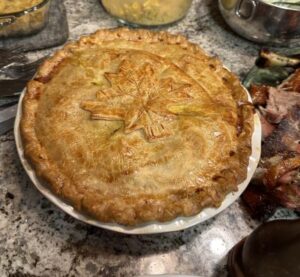
This traditional Canadian minced meat pie with nutmeg seasoned ground pork, and shredded potato, onion and carrot filling is a dish I’ve been making for decades. There are many variations across Canada, this one is mine. Traditionally served on Christmas Eve, it is often seen gracing the table of many celebrations.
Servings: 6 dinner sized servings
2 pound(s) ground pork or 1 lb ground pork, 1 pound ground beef
1 large onion, minced
1 large russet potato, shredded
2 carrots, shredded
1/4 cup(s) flour, or 2 tablespoons cornstarch
1/2 cup(s) beef stock, or chicken stock
1 teaspoon(s) dried thyme
2 bay leaves
3 tablespoon(s) sage, crumbled
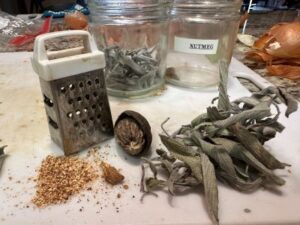
1.5 teaspoon(s) nutmeg, freshly grated
1 teaspoon(s) black pepper
1 teaspoon(s) sea salt
1 pie crust, double
1 egg, pasty wash
Directions:
Heat a large sauté pan. Add ground meat, cook until pink is gone, stirring to break up any chunks. add onions, bay, thyme, season with salt and pepper. Drain fat and reserve.
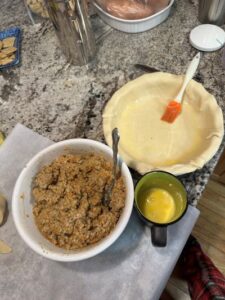
Combine cooked meat with remaining spices and herbs, shredded vegetables ,stock and flour. Remove bay leaves. Set aside.
Roll each piece of dough to ¼ inch thickness, enough to cover a 10″ pie plate with 2 inches over hang. Lay in a deep large pie pan. Brush the bottom of the pie dough with beaten egg. Fill with meat mixture.
Cover with pastry top. Fold pastry over and pinch closed. Trim excess pastry off pan and reserve for Potés recipe.
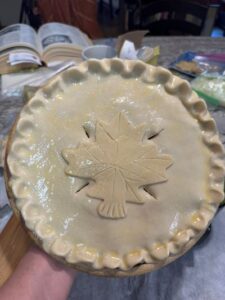
I use the pinch and forefinger method to finish the edge of the pie in this image. Brush with egg wash or milk. Cut 4 vents in a cross. Place a piece of cut dough for decoration and baste with egg again. Bake 350 degrees for 1.5 hrs or until baked through. You may need to cover the edges to prevent burning the crust before the pie is done. I typically will check the dough at the sides to get a sense of doneness.
Let cool for 10-15 minutes and cut into 1/6’s or 1/8’s. Serve with your favorite salad. You can cover with foil and store in the freezer. and then thaw to serve later.
Potés; a special treat for the bakers.
My Mémé always saved the best for last. When we finished making the pork pie, or any pie for that matter, the bakers got a special treat using the leftover dough. It is simple enough that I don’t think a recipe necessary.
Using remaining dough, roll out into a circle, make a thin layer of your favorite compote, jam or jelly whatever you have on hand. Roll the dough up in a pinwheel. and slice. Place in a greased tin, brush with milk or beaten egg and sprinkle with granulated sugar. Also, I was taught to roll it out and fill the center, fold and seal, brush with milk or beaten egg then sprinkle with sugar. Bake alongside the tourtiere for about 25- 30 minutes. Remove from the oven, let cool enough to eat and enjoy with a hot cup of tea or coffee.
Pastry 1: Hot Water Pastry Recipe
Never Fail Recipe from Loretta Jennings
Ms. Jennings and I met while travelling by bus to Toronto, we both were flying out of Pierson Airport there to visit family in British Columbia. She was an 82 year old lady who had a heart as big as Canada. I think she was from Hamilton or the greater Toronto area (The Six) but I can’t remember now. We shared a lot in common. We talked about cooking (my favorite topic), she told me she had a pie business that kept her quite busy. I lamented about my poor excuse for pie crust. She then told me her “never fail” recipe and I was absolutely touched by her generosity of spirit and open mindedness. The recipe she said, had been in her family for at least 4 generations making in around 150 years old at the time. It turns out we had more than cooking in common as we shared our stories of adoption, mine of being an adopted child, hers of being a birth mother who gave up her little girl to a loving family. She told me how she never hid the fact from her family and that some time later her ‘little girl’ found her and they were able to share their lives again. What a wonderful lady. I am blessed to have met her. Funny that I was going to visit my father who I had found only 4 years before, and she was going to visit her son. The world works in circles.
This is the best pie crust I have ever made or tasted and the easiest to work with. It makes pie making a cinch. We tried the recipe when I got to B.C., and made two tortierre, an apple and a pumpkin pie (7-9” pie crusts in all).
1 lb lard
1 cup hot water
4 cups cake and pastry flour
1 cup all purpose flour
1 tsp salt
1tsp Baking powder
Pour boiling water over the lard and smooth out then stir until creamy. Add the flour salt and baking powder and combine well. It will be very wet, so just cover with plastic wrap.
Refrigerate 4 hours or overnight. Store in fridge 3 weeks and roll as needed (keep covered). Pliable at all times and never toughens. Freezes well.
Remove the needed amount and roll out to size of dough required (1.5″ beyond edge of pie pan) for bottom crust. ¾ “ for top. I typically roll my dough about 1/8″ thick
If cooking a frozen pie; Oven at 375 degrees for 45 minutes, don’t pre heat, don’t defrost pie (fruit pie 8”)
BON APPETIT!
References;
[i] – Scully, Terence, ed. Le Viandier de Taillevent. An Edition of all Extant Manuscripts. Ottawa: University of Ottawa Press, 1988.
Source http://www.godecookery.com/goderec/grec69.htm
[ii] Du fait de cuisine 1420, by Maistre Chiquart
translated by Elizabeth Cook
http://www.daviddfriedman.com/Medieval/Cookbooks/Du_Fait_de_Cuisine/Du_fait_de_Cuisine.html
[iii] Le Cusisinier Francais by Varenne, Pierre Francois translated into English in 1653 by I.D.G. With an introduction by Philip and Mary Hyman, Southover Press 2001
2 Cockshut Road, Lewes, East Sussex BN71JH ISBN 1 870962 17 6
[iv] La cuisinière canadienne, contenant tout ce qu’il est nécessaire de savoir dans un ménage, pour préparer les diverses…. Montréal: L. Perrault, 1840 Courtesy of Collections Canada, found at http://www.collectionscanada.gc.ca/cuisine/002001-100.01-e.php, link active as of 10/20/2008
3/23/2026 Finding Environmental History in “The Wreck of the Edmund Fitzgerald” by Daniel Macfarlane
(originally published 11/7/2025 on https://niche-canada.org)
The legend lives on from the Chippewa on down
Of the big lake they called Gitche Gumee
The lake, it is said, never gives up her dead
When the skies of November turn gloomy
With a load of iron ore, twenty-six thousand tons more
Than the Edmund Fitzgerald weighed empty
That good ship and true was a bone to be chewed
When the gales of November came early
The ship was the pride of the American side
Coming back from some mill in Wisconsin
As the big freighters go, it was bigger than most
With a crew and good captain well seasoned
Concluding some terms with a couple of steel firms
When they left fully loaded for Cleveland
And later that night when the ship’s bell rang
Could it be the north wind they’d been feeling?
If the title of this post hadn’t already given it away, you might have recognized these lines as the opening stanzas of Gordon Lightfoot’s “The Wreck of the Edmund Fitzgerald.” This folk-rock ballad, released in 1976, commemorates the Edmund Fitzgerald, which sank on November 10, 1975 in Lake Superior.
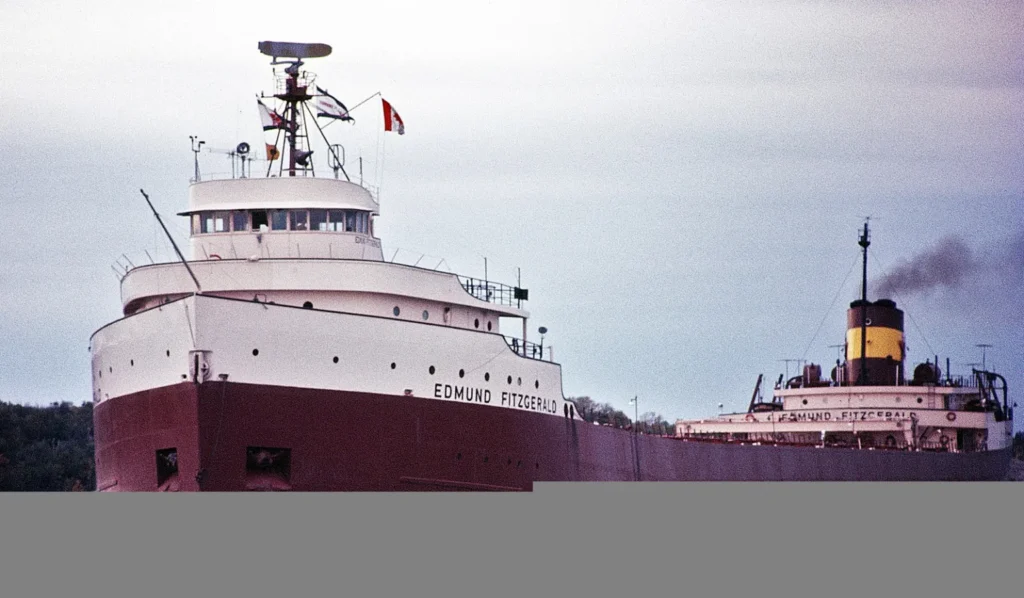
That freighter is the Great Lakes’ most famous shipwreck. This notoriety stems from a number of factors: it was the largest ship on the Great Lakes when launched in 1958; the entire twenty-nine-man crew perished; why it sank is still shrouded in mystery.
Another reason, perhaps the primary reason, this laker’s demise is so widely known: the popularity of the Canadian troubadour’s song. It might even be said this has become an anthem of the upper Great Lakes region on both sides of the Canada-U.S. border. Go to any lakeside bar for a few hours, and there’s a good chance you’ll hear this song emanating from jukebox (or, more likely these days, streaming over the sound system).
Since November 10, 2025, marks the 50th anniversary of this nautical disaster, in this post I’m going to focus on those first two stanzas from Lightfoot’s haunting song. Breaking these down two lines at a time, I’ll explore some of the environmental history themes linked with the Edmund Fitzgerald – both the song and the ship.
The legend lives on from the Chippewa on down
Of the big lake they called Gitchee Gumee
Gitchee Gumee is a transliteration of “Gichigami,” the Chippewa (an Anishinaabe group who call themselves Ojibwe) word for Lake Superior, meaning “big sea” or “great water.” That appellation for this sweetwater sea was first popularized for settler audiences by Henry Wadsworth Longfellow’s poem The Song of Hiawatha and reintroduced to contemporary audiences by Lightfoot’s song.
It’s hard to say whether Lightfoot’s mention of the Chippewa is meant to foreground the Indigenous history of the lake. These lines could be a nod toward that, but in some ways they might also mirror the type of histories so often written: a brief and paternalistic acknowledgement of the historical Indigenous presence before it quickly recedes out of view, replaced by more consequential white activities like mining and shipping.
Recent research has done a better job of highlighting the Indigenous presence here. Nancy Langston’s Sustaining Lake Superior, for example, is explicitly focused on the environmental history of the largest of the Great Lakes. Langston looks at the impacts of different types of resource extraction – many of which were intertwined with the Edmund Fitzgerald and the industrial sectors it supported – on the lake. Langston chronicles the ecological damage but also stresses the resilience of Lake Superior and the Indigenous communities on its shores.
The lake, it is said, never gives up her dead
When the skies of November turn gloomy
The choice of “her” rather than “its” in reference to Lake Superior is an interesting one. It is common for ships to be gendered female (as this one is in the last lines of the ballad), but what to make of referring to the lake as female? Is this meant to evoke her ruthless capriciousness, or portray her as something that needs to be “conquered” by masculine sailors? Or is it a way of personifying, or giving agency to, a natural feature? (As an aside, recently there have been efforts in Ohio and New York State to give other Great Lakes legal rights or personhood).
The basis for stating that Superior “never gives up her dead” seems to be an acknowledgement of the lake’s cold temperature, which preserves bodies by inhibiting decomposition. That frigidness means that Lake Superior is less biologically productive than the other Great Lakes; the much, much smaller Lake Erie is actually a much more lucrative fishery, for instance.
Lake Superior’s temperature also makes it less hospitable to many nonnative species that have bedeviled the rest of the Great Lakes. Some of the most pernicious, such as zebra and quagga mussels, infiltrated the Great Lakes after the opening of the St. Lawrence Seaway by hitching a ride in the ballast tanks of big ships like the Edmund Fitzgerald that came from overseas.
With a load of iron ore, twenty-six thousand tons more
Than the Edmund Fitzgerald weighed empty
The first large-scale mining of iron ore near Lake Superior occurred in Michigan’s upper peninsula in the mid-19thcentury. Soon other ore ranges around the lake were developed, and this resource became one of the main commercial cargos shipped on Lake Superior. Locks at the Soo were installed to facilitate transportation through the St. Marys River, in large part to send the ores to steel mills throughout the Great Lakes basin. By the end of the 19th century, the Mesabi Range at the western end of Lake Superior was recognized as the world’s most productive iron ore source, and the Soo locks were enlarged a number of times to handle the maritime traffic.
After the more easily accessible iron ore had been mined out by the mid-20th century, the focus turned toward lower-grade taconite. To convert taconite into a usable form, it is pelletized – a process frequently done on Lake Superior’s shores. Indeed, when the Edmund Fitzgerald went down it was laden with 26,116 long tons of these pellets, which had been refined right at its disembarkation point at Superior, Wisconsin. Iron ore mining and processing led to all kinds of pollutants, many toxic, flowing into Lake Superior.
That good ship and true was a bone to be chewed
When the gales of November came early
November is renowned as the most dangerous month for Great Lakes freighters, many of which, including the Edmund Fitzgerald, were trying to fit in one more run before the shipping season closed. The storm that sunk the Edmund Fitzgerald was reputedly a “bomb cyclone” with winds close to hurricane force: sustained speeds over 60 miles per hour and gusts up to 85 mph. Waves were 25-35 feet, and rogue waves may have been closer to 50 feet.
As we know now, by the mid-1970s climate change was already messing with the weather of the Great Lakes region and making extreme weather events more likely and more intense. Moreover, just a few months before the Edmund Fitzgerald sank, an article was published by a geophysicist in Science that has been credited with popularizing the term “global warming.”
Was this storm attributable to climate change? That would be too simplistic an assessment. Though the weather was extreme, it wasn’t out of the range of normal storms at that time of year. Not to mention that the ship may not have sunk if it wasn’t for a combination of the weather and human error (one of the leading theories is that the Edmund Fitzgerald struck a reef).
The ship was the pride of the American side
Coming back from some mill in Wisconsin
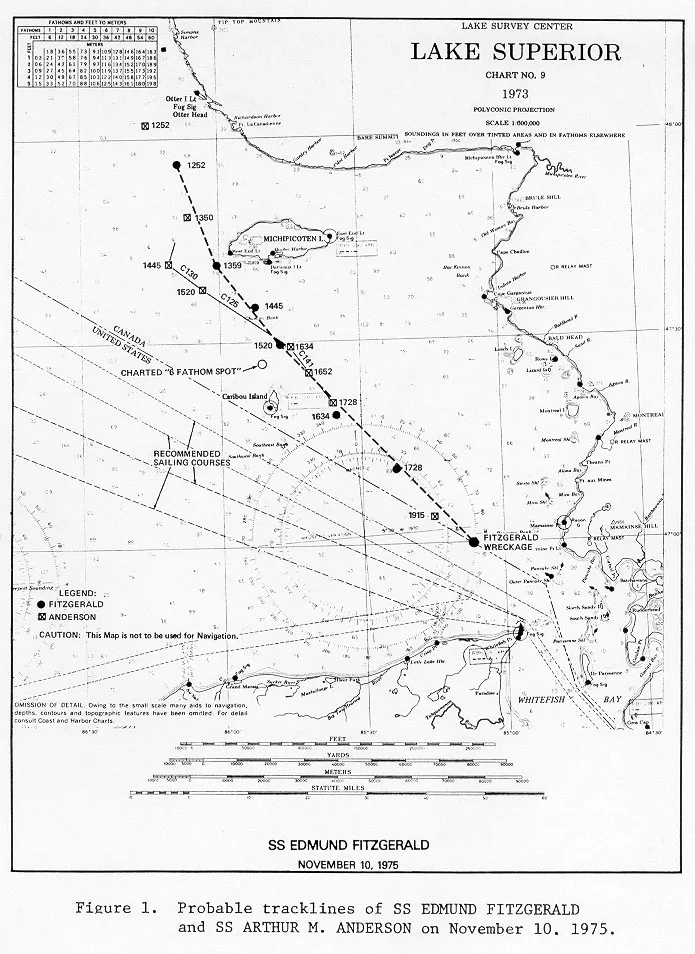
To start its fateful journey, the Edmund Fitzgerald left Burlington Dock No. 1 (the largest iron ore dock in the world at the time) in mid-afternoon of November 9. Its cargo came from U.S. territory, its destination was in the United States, and the crew was American. But the ship sank in Canadian waters near the east end of Lake Superior.
This points to the fact that the Great Lakes are, aside of Lake Michigan, transborder waterbodies. That fact has played an enormous role in the governance and usage of these lakes and their connecting waters. Canada and the United States signed the Boundary Waters Treaty in 1909, which created the International Joint Commission. This commission was responsible for approving and regulating the different remedial works – canals, dams, hydroelectric stations – in the St. Marys River that affect the flow regime out of Lake Superior.
In addition to the St. Marys River, the IJC coordinated many of the extensive hydraulic engineering interventions undertaken to facilitate navigation elsewhere in the Great Lakes basin. For boats such as the Edmund Fitzgerald to get to Lake Erie, they transited the St. Clair and Detroit connecting channels, both of which had been deepened, dredged, and altered since the nineteenth century. Furthermore, the Edmund Fitzgerald was originally launched in conjunction with the opening of the St. Lawrence Seaway and Power Project, which encompasses the Welland Canal as well as the replumbing of the eponymous river to allow big ships to sail through.
As the big freighters go, it was bigger than most
With a crew and good captain well seasoned
The Edmund Fitzgerald is the biggest boat to ever sink in the Great Lakes. The Great Lakes Ship Museum estimates that a total of 6,000 lives and 30,000 vessels have been lost on these inland seas. There have been approximately three million shipwrecks worldwide over the course of human history; about three-quarters of this total are believed to have resulted from the two world wars of the twentieth century.
Over time, the metal of modern shipwrecks corrodes, potentially releasing oil and other chemicals, depending on their cargo. Military vessels often have munitions which contain toxic pollutants such as mercury. Some military shipwrecks aren’t accidental either: many were deliberately sunk when they became obsolete.
In 2010, the U.S. Congress gave the National Oceanic and Atmospheric Administration (NOAA) $1 million to undertake a study titled Remediation of Underwater Legacy Environmental Threats (RULET). The point was to identify wrecks in U.S. waters that posed a pollution threat. Completed in 2013, this survey identified 87 high-level risk wrecks.
To use just one Great Lakes example, during the 1930s a barge sunk in Lake Erie carrying a reported 4,752 barrels of crude oil and benzol. This, and many other shipwrecks, were still slowly releasing pollutants into their host waters. In 2015, most of the potential pollutants were pumped out of this Lake Erie wreck by the Coast Guard. Congress then appropriated $1 million in 2020 so that NOAA could further review and prioritize potentially polluting shipwrecks.
Interestingly, wrecked ships can provide habitat for a diverse range of aquatic organisms. My colleague Lynne Heasley has written about these and other eco-industrial relationships in her book The Accidental Reef and other Ecological Odysseys in the Great Lakes (and, in a nod to the subject of this post, has two cats named Eddie and Fitz). There is even an emerging subdiscipline of scientific study called shipwreck ecology.
Concluding some terms with a couple of steel firms
When they left fully loaded for Cleveland
When it sank, the Fitzgerald wasn’t headed for Cleveland, but for Zug Island (Detroit), and then to Toledo to lay up for the winter. Lightfoot was reportedly quite concerned with the accuracy of his song, and even later changed some of the lyrics for live shows. Given that the ship’s destination was widely reported in the press, this mistake about the port of call is curious. It appears that the use of Cleveland, rather than the correct destination, is attributable to the need for a rhyming couplet in this A-B-C-B rhyme scheme (i.e., the Ohio city rhymes with “seasoned”).
Cleveland is also a well-known steelmaking area. To be sure, for a long time the Great Lakes basin hosted the world’s greatest concentration of steelmaking centers, with such coal-burning facilities and allied industries peppered all along the lakeshores. This industry has been responsible or more than a century’s worth of dangerous chemicals and waste going into the Great Lakes. This pollution was one of the reasons that the U.S. and Canada signed the Great Lakes Water Quality Agreements in the 1970s.
And later that night when the ship’s bell rang
Could it be the north wind they’d been feeling?
Since a sudden north wind on Superior indicates an imminent storm, according to sailor lore, this line offers a foreboding transition marking the crew’s growing awareness that the weather was turning foul. It can serve here as a transition to some concluding remarks on the legacy of the Edmund Fitzgerald.
In response to the vessel’s sinking, a number of regulations and procedures were changed to prevent similar disasters. Indeed, there has been no major shipwreck on the Great Lakes since. After a great deal of persistence by relatives of the shipwreck’s victims, in the 21st Century the Canadian government made the resting place of the Edmund Fitzgerald a protected marine heritage site. This means it is not legally accessible for divers or explorers.
A ceremony to remember the Edmund Fitzgerald happens every year at the Great Lakes Shipwreck Museum at Whitefish Point, plus another private event for the crew’s families. Lightfoot regularly joined the surviving relatives for memorial activities. Unfortunately, the singer won’t be able to join in the 50th anniversary events since he passed away in 2023. Nevertheless, special anniversary ceremonies are planned for the Shipwreck Museum as well as the National Museum of the Great Lakes in Toledo and the Mariners’ Church of Detroit, among others.
If you attend one these memorial events, or find yourself toasting the Edmund Fitzgerald in some lakeside shanty, you’re all but guaranteed to hear the poignant strains of Lightfoot’s iconic tune.
About the author:
Daniel Macfarlane is a Professor in the School of Environment, Geography, and Sustainability at Western Michigan University. He is an editor for The Otter-La loutre and is part of the NiCHE executive. A transnational environmental historian who focuses on Canadian-American border waters and energy issues, particularly in the Great Lakes-St. Lawrence basin, Daniel is the author or co-editor of six books on topics such as the St. Lawrence Seaway, border waters, IJC, and Niagara Falls. His book “Natural Allies: Environment, Energy, and the History of US-Canada Relations” was published in summer 2023. His newest book is “The Lives of Lake Ontario: An Environmental History” (September 2024). He is now working on a book about Lake Michigan, co-editing a book on the St. Clair River/Delta/Lake, and is planning to eventually write a book on the environmental history of the Great Lakes. Website: https://danielmacfarlane.wordpress.com Twitter: @Danny__Mac__
1/28/2026 Historical Research by Janine Guimont Cotugno
Janine is part of the Kalamazoo Valley Genealogical Society and a friend to Canadiana Fest! This article was first published in “Je Me Souviens”, the quarterly journal of the American French Genealogical Society Fall 2017, Volume 2, Number 2, pp. 12-15
It is posted on this website by permission of the author.
————————————————————————————————————-
I’M A MICHIGANDER TOO
Maurice Menard and Madeleine Couc
By
Janine Guimont Cotugno
I grew up in Rhode Island, the product of French-Canadian ancestry. In the many years of researching my genealogy at the AFGS library, I uncovered generations of ancestors who sailed from France to Canada and whose descendants eventually immigrated to work in the textile mills of New England. When I moved to Michigan in 2010, I appreciated my adopted state, but was not able to connect directly to its past. That changed as I learned more about the French who explored and settled the Great Lakes region in the 1600s and 1700s. I kept seeing the name “Michilimackinac” in historical readings, and remembered that I had also seen that very name in my own family tree. Rummaging through my genealogical database, I discovered that my eighth great- grandparents, Maurice Menard and Madeleine Couc, had married in Michilimackinac, and I’ve learned that it was an important location in the early history of Michigan. Through that connection, I am a Michigander too.
The area called Michilimackinac in the 1600s and 1700s encompassed from what is now St. Ignace, Michigan, at the southeastern tip of Michigan’s Upper Peninsula, to Mackinaw City, Michigan, at the northern-most tip of the state’s Lower Peninsula. In this area are important straits that connect Lake Huron to Lake Michigan. Because Michilimackinac was the doorway to the western territories and their vast fur supplies, the French built Fort de Buade in St. Ignace in 1690. That fort closed in 1698, due to the depressed fur market in France. However, between 1712 and 1715, a new battlement, Fort Michilimackinac, was built on the south side of the straits in Mackinaw City. (1)
My eighth great-grandfather, Maurice Menard, married Marie Madeleine Couc, the daughter of Pierre Couc dit Lafleur de Cognac (also sometimes called ‘dit Lefebvre’) and the Algonquin woman, Marie Miteouamegoukoue (Mite8ameg8k8e), most likely at Michilimackinac/St. Ignace. Maurice, a well-known voyageur (legal fur trader) and Native language interpreter, was born on June 7, 1664, in Trois-Rivieres, the son of wheelwright Jacques Menard dit Lafontaine and Catherine Fortier. Madeleine was born a few years later, around 1669. (2) Her parents’ marriage in 1657 was one of the first marriages between a French settler and an indigenous woman recognized by the Catholic Church in New France. Many of their other children were also active as voyageurs (or spouses of these) and interpreters, frequently under the “dit” name of Montour.
The date of the marriage between Maurice Menard and Madeleine Couc is not totally clear, as the original early church records from Michilimackinac have not survived. Some secondary sources list a possible marriage date of 1692 (3) (4), but it appears to me that children may have been born before that time. Sommerville believes the Menard/Couc union probably occurred around 1690. Perhaps they had a “country wedding” (common law) or Native American ceremony, since Madeleine was half Algonquin. A church blessing could have been later bestowed (perhaps in1692) at the Mission Church at Fort DeBuade.
Maurice and Madeleine had several children. I am a descendant of their daughter, Marguerite Menard. Again, multiple sources list several different dates and locations of birth for the children. Considering what I’ve found in my research, this is my best estimate of the list of Maurice and Madeleine’s children (5):
Marguerite – b. circa 1690-94, assumed at Michilimackinac
Marie-Madeleine – b. circa 1690-94, assumed at Michilimackinac
Antoine – b. 28 April 1695 at Michilimackinac
Louis – b. 1697 at Michilimackinac
Pierre – b. 12 March 1701 in Boucherville
Jean-Baptiste –b. 11 July 1703 in Boucherville
Susanne – b.21 July 1706 in Boucherville
Francois – b. 6 February 1709 in Boucherville
Infant Daughter – b. 20 July 1711 in Boucherville; d. 24 July 1711 in Boucherville
With Fort de Buade closed, illegal fur trapping and trading by “coureurs de bois” continued uncontrolled in the Michilimackinac area. In 1706, at the insistence of the Governor General of New France, a Jesuit priest by the name of Fr. Marest returned to St. Ignace with a summer brigade, which included the interpreter, Maurice Menard. Without a fort, the presence of a missionary at least provided the government with detailed reports on the affairs that took place there (6).
In Fr. Marest’s letters to the Governor, the Marquis de Vaudreuil, Maurice Menard is mentioned often, especially as it related to dealings with the indigenous peoples. The following excerpt from the priest’s letter of 14 August 1706 describes Fr. Marest’s respect for Maurice:
“I thought …that it was not advisable for the Sr. Menard to leave here until we were settled in the fort. I believe you will not disapprove, because it is a question of our safety…You have certainly every reason to be pleased with the Sr. Menard, who is beloved by the savages, who knows their ways, who has no difficulty in answering them, and that with a free and easy manner, ever cheerful. He discovers things which are done secretly, and, certainly, whether he comes here as commanding officer or not, he would render good service here.” (7)
In a subsequent letter from Fr. Marest, dated 27 August 1706, he continues to praise Maurice:
“The Sr. Menard…has certainly done his duty, and has shown in everything, that he is in truth the King’s servant and yours. If anyone should make complaints to you about him I can assure you he would be very wrong.” (8)
Timothy Kent, in his book “Rendezvous at the Straits”, confirms my research and summarizes Menard’s life up to that point:
“Maurice had worked at Fr. De Buade as a soldier, interpreter, and trader during the 1680s and 1690s, marrying Madeleine (Couc) there in 1692 and assisting in the raising of their first four children there, until the official withdrawal of troops in 1698. While living in Boucherville, just east of Montreal, during the next fourteen years, the family continued to grow, with the addition of five more children…Upon the return of the first few soldiers to the Straits in 1712, Maurice also resumed living there, where he again served as a sergeant, interpreter, and trader. In time, his family joined him, eventually residing at Ft. Michilimackinac when its construction was completed on the southern shore of the Straits. “(9)
Because Maurice Menard was so respected by the Natives and the authorities, he frequently took part in negotiations between the French government and various tribes. In many documents, he is listed as “Interpreter for the King”, showing that he was representing the Governor General of New France, and therefore, indirectly the King of France.
However, being a government interpreter was at times very dangerous. In a letter to the Ottawa chiefs, the Governor General of New France, the Marquis de Vaudreuil, wrote the following:
“I know there are well disposed men among you; Chamgonueschi and Makakous are such men, for last year they prevented Maurice my interpreter from being stabbed.”(10)
In 1717, a peace treaty with the Fox tribe was negotiated. Several representatives of the Fox chiefs and their families had been taken from the Green Bay, Wisconsin area and transported down to the St. Lawrence valley to finalize the treaty. (11) During the winter, smallpox raged through eastern Canada and several of the Fox died. We know that Maurice Menard was involved in these events because he is listed as a witness (godfather) to a few of the Fox victims, including the chief, Pemoussa, as they converted to Catholicism before their deaths. (12) In the spring, de Vaudreuil sent the soldier officer, de Louvigny, to deliver one of the survivors back to the tribe. Vaudreuil wrote:
“The two principal hostages of the Fox Indians died of it (smallpox)…As there was some ground for fearing lest the death of these two hostages might disturb the Fox tribe and might be made a ground for breaking the peace…. I sent with the Sieur de Louvigny the chief of the three hostages who had escaped the disease so that he might go and inform his tribe of the good treatment which they received….Sr. de Louvigny sent the men (Maurice) Menard and (Pierre) Reaume, interpreters, and gave into their charge some presents which I had given him to cover the dead hostages. This ceremony was performed by the interpreters as soon as they arrived,…after which the Fox Indians testified that they retained no resentment for the death of Pemoussa and Michiousouigan.” (13)
One can only wonder what would have happened to Maurice and the other Frenchmen if the Fox had not been so understanding!
We know that Maurice continued in his work at the fort at least until 1736, as he is listed in a contract notarized by F. Lepailleur de LaFerte as “interpreter at the Misilimakinac Post”. When he eventually retired, it was to property in Chambly. (14)
Maurice Menard died on 9 May 1741 in Chambly at age 76, after more than 50 years of devoted service and many thousands of miles of voyaging the rivers and lakes of North America as a fur trader, interpreter and mediator for the French with the indigenous peoples. Records say that “all the inhabitants (of Chambly) were present as witnesses at his burial.” (15)
One does not need to be from Michigan nor the Great Lakes area to be descended from these important pioneers. As mentioned above, I am descended from their daughter, Marguerite, who married Pierre Boileau on 5 July 1706 in Boucherville (16) and apparently spent the rest of her life in the St. Lawrence valley. Although a few of the Menard children spent some additional time in the Michigan area as voyageurs, interpreters and inhabitants of Fort Michilimackinac and Fort St. Joseph, records show that most married, resided and/or frequently died in the Boucherville and Chambly areas. (17) Through these Menard children, you too may be a descendant of this influential couple, Maurice Menard and Madeleine Couc.
END NOTES
- “A Brief History of Michilimackinac”, < http://www.mackinacparks.com/history> (accessed 7/16/2013).
- Tanguay, Cyprien. Dictionnaire Genealogique des Familles Canadiennes. Montreal: Eusibe Senecal, 1871. Vol 1, 3 & 5.
- Sommerville, Suzanne. “Part 3 – The Couc dit Lafleur de Cognac Children”. All Sources Are Not Created Equal. CD-ROM. Royal Oaks, M.I.: French Canadian Heritage Society of Michigan, 2009, p. 45-46.
- Morin, Gail. First Metis Families of Quebec – 1622-1748. Baltimore: Genealogical Publishing Company, 2012, p. 23.
- Ibid, p. 24.
- Kent, Timothy F. Rendezvous at the Straits. Ossineke, M.I.: Silver Fox Enterprises, 2004, p.168.
- Michigan Pioneer and Historical Society. “The Cadillac Papers”. Historical Collections, Vol. 23. Lansing: Robert Smith Printing, 1904, p.267-68.
- Ibid, p. 270.
- Rendezvous at the Straits. p. 249.
- “The Cadillac Papers”, p. 584.
- Corkran, D.H. “Permoussa.” Dictionary of Canadian Biography Vol. 2. University of Toronto/Universite Laval, 2003. (accessed 1/13/2017), <http://www.biographi.ca/en/bio/permoussa_2E.html>.
- “Marie Madeleine Couc & Maurice Menard – Notes from Suzanne Sommerville”. <http://www.leveille.net/ancestery/MadeleineCouc/MauriceMenard.htm>. (accessed 1/4/2014).
- “The Cadillac Papers”, p. 588-89.
- “Interpreters”. <http://www.leveille.net/ancestry/interpreters.htm#menard> (accessed 9/5/2013).
- “Marie Madeleine Couc & Maurice Menard – Notes from Suzanne Sommerville”.
- “Marriage Certificate – Pierre Boileau & Marguerite Menard”. <http://www.leveille.net/ancestry/register/M1706PierreBoileauMargueriteMenard.htm>
(accessed 7/11/2014).
- First Metis Families of Quebec, p. 24.
Some corrections made March 2021